
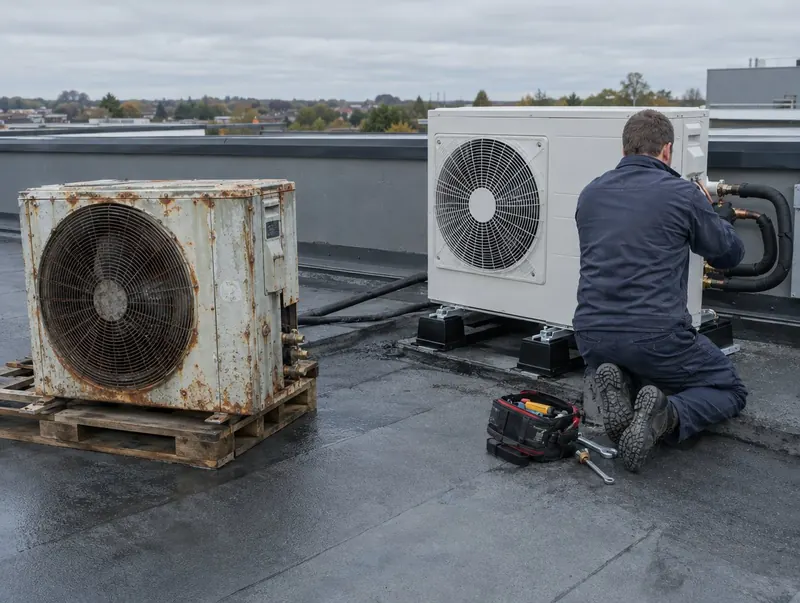
Air conditioning replacement and upgrades in London
Cooling and heating for offices, shops and hospitality venues in London, with a free site survey and a fixed written quote.
- Free site survey and fixed written quote
- Unit sizes, refrigerant and price set out in writing
- Work planned around your opening hours
How much does it cost to replace air conditioning in London?
In London, guide prices run from about £2,095 to £5,695 per indoor unit, plus VAT. A typical job (replacing a 3–4 unit system, re-using sound pipework) usually comes to £7,595–£18,550 plus VAT. The fixed price follows a free survey.
Air conditioning replacement is removing an old system — often one using R22 or R410A refrigerant — and installing new, more efficient equipment, re-using pipework where it is safe and compatible.
London and surrounding areas
We cover all of London, including Brent, Islington, Bexley, Barking and Sutton. Wherever your premises are, the survey, quote and installation follow the same steps.
Postcode districts we cover include BR1, E16, EN5, N16, SE7, SW8, W1 and WC2R. For air conditioning replacement in London, the survey looks at where the outdoor unit can go, how pipework will reach the indoor units and whether the electrical supply has capacity.
Included as standard
- Condition survey of the existing system
- Pipework re-use assessment, flushing where suitable
- Refrigerant recovery with waste transfer documentation
- Installation of new efficient units
- Commissioning and new F-gas records
Prices in London
Guide prices for London, set for London. Your fixed price comes in writing.
| Item | Guide price (ex VAT) | Inc VAT | Basis |
|---|---|---|---|
| Like-for-like split replacement | £2,095–£4,395 | £2,514–£5,274 | per system |
| Cassette replacement | £2,750–£5,695 | £3,300–£6,834 | per unit |
| Refrigerant recovery and disposal | £245–£760 | £294–£912 | per system |
| Pipework flush and test (re-use) | £245–£760 | £294–£912 | per circuit |
Ex VAT, supply and install.
The steps for a project in London
Survey
We record what is installed, its condition and refrigerant, and what can be re-used. For sites in London we confirm access and parking beforehand.
Plan the swap
Removal and installation are scheduled to keep downtime short.
Recover and remove
Refrigerant is recovered into certified cylinders and the old units removed.
Install and commission
New units are fitted, tested and commissioned with fresh records.
What to think about in London
Disposal
Old refrigerant must be recovered by certified engineers and the units disposed of as waste electrical equipment.
Shared buildings
In multi-let buildings, roof space, risers and plant areas are often controlled by a managing agent. We work to their permits and method-statement requirements.
Downtime
We schedule the swap to keep the space usable, often over a weekend.
Working hours
Most London businesses prefer noisy work outside trading hours. Early starts, evenings and weekends can be arranged and are priced up front.
Types of premises we cover in London
- Salons and spas: comfortable salons and treatment rooms despite dryers, lamps and steam.
- Retail and shops: comfortable shop floors, stockrooms and entrances, even with the door open.
- Hotels and hospitality: quiet bedroom units, public-area cooling and heat recovery for hotels.
- Gyms and leisure: high-capacity cooling and fresh air for gym floors, studios and changing rooms.
Two rules matter for most businesses in England: GB F-gas rules (leak checks from 5 tonnes CO2e) and the periodic energy inspection for more than 12 kW of air conditioning.
FAQs for London
How much does it cost to replace air conditioning in London?
Guide prices in London run from about £2,095 to £5,695 per indoor unit, plus VAT. A typical job (replacing a 3–4 unit system, re-using sound pipework) costs £7,595–£18,550 plus VAT. We fix the price in writing after a free survey.
Do you also cover Surrey, Hertfordshire and Essex?
Yes. Alongside London, we also cover Surrey, Hertfordshire and Essex. Each has its own page with local guide prices.
Will a new system be cheaper to run?
Usually. Modern inverter systems are considerably more efficient than equipment from 15–20 years ago, though savings depend on use.
Should we replace R410A systems now?
Not necessarily. If an R410A system is working well and maintained, keep it. Plan replacement when it becomes unreliable or expensive to run.
Need air conditioning replacement in London?
Free survey and fixed written quote. We reply with a guide price or to book the survey.