
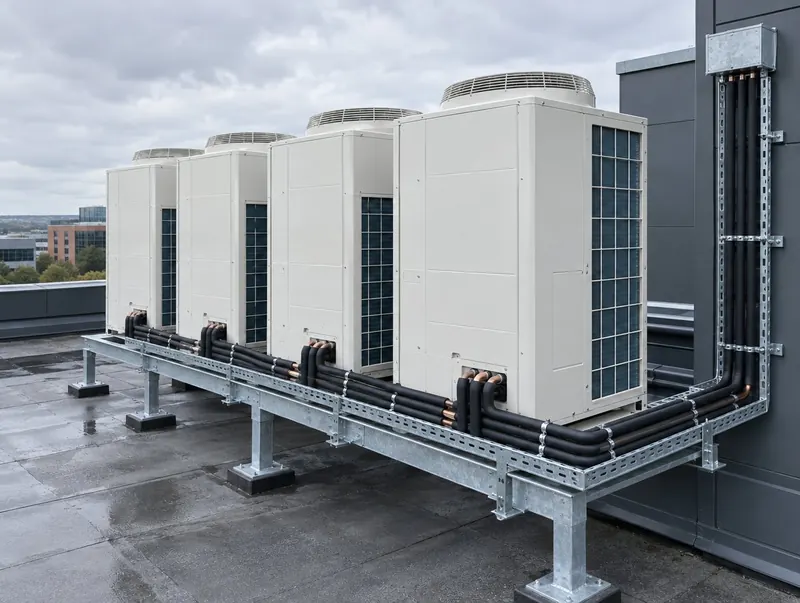
VRF and VRV systems
Multi-zone systems that heat and cool a whole floor or building from shared outdoor plant. Free survey for mainland installations, and a fixed written quote.
- Free site survey and fixed written quote
- Unit sizes, refrigerant and price set out in writing
- Work planned around your opening hours
What are VRF and VRV systems?
VRF (variable refrigerant flow) — called VRV by some manufacturers — is a commercial air conditioning system where one outdoor unit, or a bank of them, serves many indoor units through a shared refrigerant network. It varies the flow of refrigerant to each indoor unit, so every zone can be controlled separately, and heat recovery versions can cool some rooms while heating others.
In the UK, guide prices run from about £2,450 to £4,950 per indoor unit (whole system), plus VAT. A typical job (office floor of 10–16 indoor units) usually comes to £24,500–£79,500 plus VAT.
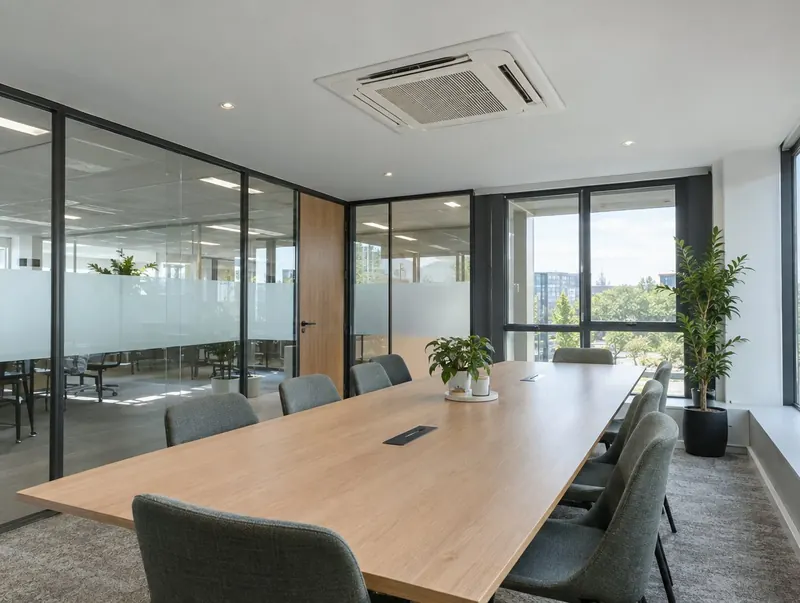
VRF is the usual answer once a building needs more than a handful of indoor units. A single outdoor unit can serve dozens of indoor units of different types — cassettes, ducted units, wall units — on one refrigerant network, with central controls and much less roof space than separate splits.
Heat recovery VRF goes further: it moves heat from rooms that need cooling (south-facing offices, server rooms) to rooms that need heating (north-facing areas, reception) at the same time. On the right building that is a real running-cost saving. We design the pipework, branch boxes and controls, and plan installation so floors can stay occupied.
Where it suits
- Multi-storey offices
- Hotels and serviced apartments
- Schools and colleges
- Mixed-use and retail parks
- Healthcare and care homes
- Refurbishments replacing ageing split systems
What is included
- Heat load and diversity calculations for every zone
- Two-pipe (heat pump) or three-pipe / two-pipe heat recovery system design
- Refrigerant pipework sizing, branch selectors and refrigerant charge calculation
- Leak detection where the refrigerant concentration limits require it
- Central controls, scheduling and BMS integration
- Phased installation, pressure testing, commissioning and full F-gas records
How the work is carried out
Survey and loads
We calculate loads zone by zone and check roof or plant space, risers and ceiling voids.
System design
Outdoor units, indoor units, branch boxes and pipe sizes are designed together, including the refrigerant charge and any leak detection.
Phased first fix
Pipework and controls cabling go in floor by floor, often out of hours in occupied buildings.
Pressure test and charge
The network is pressure tested, evacuated and charged with the calculated refrigerant quantity.
Commissioning
Each indoor unit is commissioned and the controls set up, with as-fitted drawings and F-gas records handed over.
VRF / VRV prices
National guide prices for 2026. Local pages show prices adjusted for each region.
| Item | Guide price (ex VAT) | Inc VAT | Basis |
|---|---|---|---|
| Heat pump VRF, per indoor unit | £2,450–£4,450 | £2,940–£5,340 | per unit |
| Heat recovery VRF, per indoor unit | £2,950–£4,950 | £3,540–£5,940 | per unit |
| Central controller and BMS interface | £945–£3,950 | £1,134–£4,740 | per system |
| Refrigerant leak detection (per alarmed room) | £395–£895 | £474–£1,074 | per room |
| Crane lift for roof plant | £945–£2,950 | £1,134–£3,540 | per lift |
Ex VAT, installed system prices including outdoor plant shared across indoor units.
Large or complex buildings are always priced from a full design.
Typical job: office floor of 10–16 indoor units — £24,500–£79,500 plus VAT.
Things to plan for
Refrigerant in occupied rooms
Because one network carries a large refrigerant charge, small rooms on the system are checked against the safety limits in BS EN 378 and may need leak detection.
Leak checks
Larger VRF systems usually exceed 5 tonnes CO2 equivalent, so they need at least annual F-gas leak checks — more often at 50 tonnes and above.
Plant space
Outdoor units need clear air flow, structural support and safe access for servicing.
Phasing
In occupied buildings we plan the work floor by floor so the business keeps running.
Questions about VRF / VRV
What is the difference between VRF and VRV?
None in practice. VRV is one manufacturer's trademark; VRF is the generic name for the same type of system.
When is VRF better than separate split systems?
Usually once you need more than about six to eight indoor units, want central control, or are short of space for outdoor units. One outdoor unit can replace many.
What is heat recovery VRF?
A version that can cool some zones and heat others at the same time, moving heat around the building instead of dumping it outside.
How long does a VRF system last?
With regular servicing, commercial VRF equipment commonly runs for 15 years or more. Lifespan depends on use, maintenance and the operating environment.
Does a VRF system need F-gas leak checks?
Usually yes. Most VRF systems hold enough refrigerant to exceed 5 tonnes CO2 equivalent, which triggers at least annual leak checks and record keeping.
Can VRF connect to our BMS?
Yes, through the manufacturer's interface. We specify the right gateway at design stage.
Premises we fit this for

VRF / VRV near you
Choose your county or region for local guide prices and the towns we cover.
England
- Bedfordshire
- Berkshire
- Bristol
- Buckinghamshire
- Cambridgeshire
- Cheshire
- Cornwall
- County Durham
- Cumbria
- Derbyshire
- Devon
- Dorset
- East Riding of Yorkshire
- East Sussex
- Essex
- Gloucestershire
- Greater Manchester
- Hampshire
- Herefordshire
- Hertfordshire
- Isle of Wight
- Kent
- Lancashire
- Leicestershire
- Lincolnshire
- London
- Merseyside
- Norfolk
- North Yorkshire
- Northamptonshire
- Northumberland
- Nottinghamshire
- Oxfordshire
- Rutland
- Shropshire
- Somerset
- South Yorkshire
- Staffordshire
- Suffolk
- Surrey
- Tyne and Wear
- Warwickshire
- West Midlands
- West Sussex
- West Yorkshire
- Wiltshire
- Worcestershire
Scotland
What happens next
Tell us what you need
Use the form, the quote tool, live chat or call us. A postcode and the type of premises is enough to start.
Survey or visit
For mainland installations we survey free of charge. Service and repair visits, and travel to remote locations, are priced before we book.
Written quote
You get the specification, the price and the programme in writing, including any landlord or planning points.
Work and handover
We install, service or repair around your hours, then hand over the commissioning and F-gas records.
Tell us about your premises
Send a few details and we will arrange a survey or call you back with a guide price.