
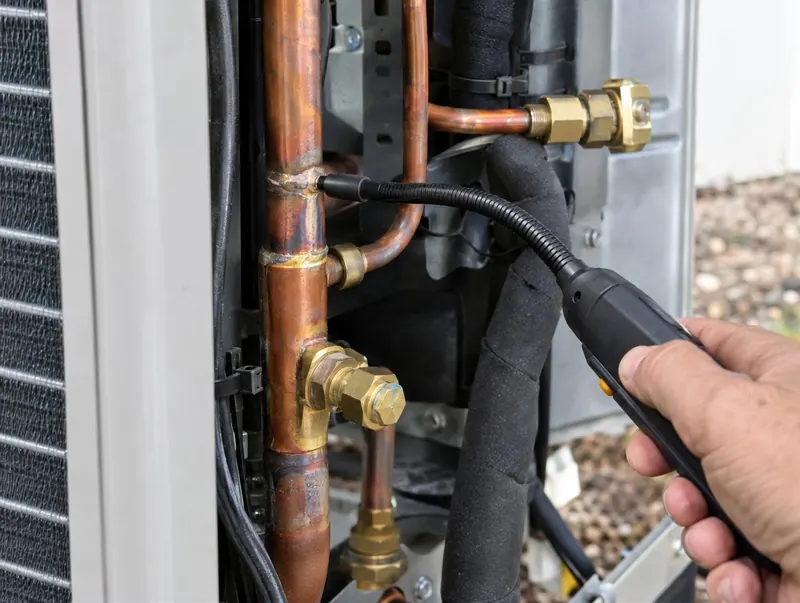
F-gas leak checks and records in Washington
F-gas leak checks for premises in Washington, with records you can show an inspector or insurer.
- Price confirmed before booking
- Every system listed and checked
- Records you can show an inspector
How much do F-gas leak checks cost in Washington?
In Washington, guide prices are about £135–£230 per visit, first system, plus VAT. A typical job (leak checks on 3–6 systems in one visit) is £260–£820 plus VAT. You get the price before the visit is booked.
An F-gas leak check is a legally required inspection of air conditioning and refrigeration equipment containing fluorinated gases at or above 5 tonnes CO2 equivalent.
Covering Washington and nearby
Washington supports a mix of high-street retail, professional offices, hospitality and light industry. Sunderland is about 9 km away.
We work across Washington's postcode districts, including NE37, NE38 and RH20. Nearby, we also cover Chester-le-Street (about 6 km), Houghton-Le-Spring (about 7 km) and Hebburn (about 8 km). Many buildings have a mix of older and newer systems, so we record each one separately and nothing is missed.
What you get
- Refrigerant type, charge and CO2e calculation for each system
- Leak check by an F-gas certified engineer
- Direct and indirect checks to the required method
- Labels and records updated
- Follow-up check within one month of any repair
Local guide prices for Washington
Prices below include our regional adjustment for the North East (6% below the UK guide).
| Item | Guide price (ex VAT) | Inc VAT | Basis |
|---|---|---|---|
| Leak check, first system (includes attendance) | £135–£230 | £162–£276 | per visit |
| Each additional system, same visit | £60–£120 | £72–£144 | per system |
| F-gas asset register set-up | Up to £370 | Up to £444 | per site |
| Automatic leak detection system | £745–£2,750 | £894–£3,300 | per system |
Ex VAT. Leak checks are often combined with a service visit at no extra attendance charge.
How a visit in Washington works
Asset check
We record each system's refrigerant type and charge and calculate its CO2e.
Set the frequency
Each system gets the legal interval for its CO2e and any automatic leak detection.
Check
The engineer checks joints, valves, components and operating data for signs of leakage.
Record
Results are recorded and kept on your F-gas log for at least five years.
Points to plan for in Washington
Operator duty
The legal duty sits with the operator — the person or business with actual control over the equipment.
Neighbours and noise
Outdoor units near flats — common above shops — need careful siting so noise at neighbours' windows stays low. We choose positions and quieter units with that in mind.
Repairs
If a leak is found it must be repaired without undue delay and re-checked within one month.
Access and parking
Town-centre jobs in Washington often come down to access — loading restrictions, parking for the van and getting equipment onto a roof. We check this at survey and plan deliveries around it.
Premises we work in around Washington
- Hotels and hospitality: quiet bedroom units, public-area cooling and heat recovery for hotels.
In England, systems holding 5 tonnes CO2 equivalent of refrigerant or more fall under GB F-gas rules, with regular leak checks and records; buildings with more than 12 kW of air conditioning in total also need a periodic energy inspection.
Common questions from businesses in Washington
How much do F-gas leak checks cost in Washington?
In Washington, guide prices are around £135–£230 per visit, first system, plus VAT; a typical job (leak checks on 3–6 systems in one visit) is £260–£820 plus VAT.
Do you also cover Chester-le-Street, Houghton-Le-Spring and Hebburn?
Yes. Alongside Washington, we also cover Chester-le-Street, Houghton-Le-Spring and Hebburn. Each has its own page with local guide prices.
Which postcodes do you cover in Washington?
All of them, including NE37, NE38 and RH20. Give us your postcode when you enquire and we will confirm the visit details.
Who is responsible for F-gas compliance?
The operator of the equipment — normally the business with control over it. Contractors do the checks; the operator must make sure they happen and keep records.
How often are leak checks needed?
At least every 12 months from 5 tonnes CO2e, every 6 months from 50 tonnes, and every 3 months from 500 tonnes. Where automatic leak detection is fitted, each interval doubles to 24, 12 and 6 months.
Get a guide price for Washington
The visit price is agreed before we book. We reply with a guide price or available dates.